
The real advantage of Chinese manufacturing is not cost anymore
When people in Europe talk about Chinese manufacturing, the conversation still tends to fall into the same trap: cost.
Of course, cost still matters.
It matters a lot.
Anyone who works with products knows that pricing, margins, volumes and competitiveness remain central factors in every industrial decision.
But if we reduce China’s manufacturing strength to cost alone, we miss the point.
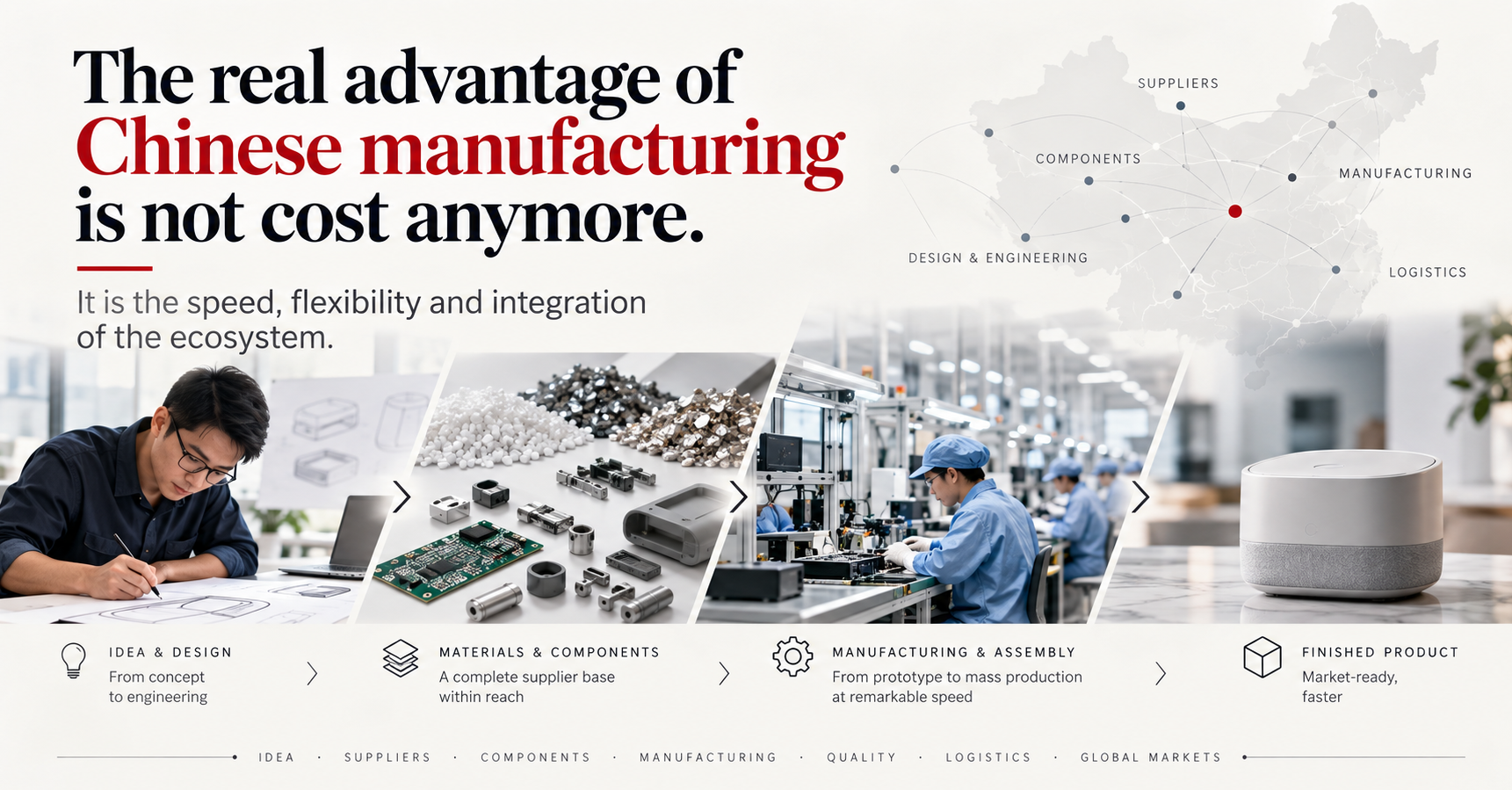
Today, the real advantage of Chinese manufacturing is increasingly elsewhere: in the structure of the ecosystem, in its flexibility, and in the speed with which a design can become a real product.
A recent article in Il Foglio, starting from the Gucci case, touched an important point. The issue is not simply whether China is cheaper, or whether Italy has lost its technological know-how. In many sectors, Italian manufacturing still has excellent competencies, machinery, materials expertise and technical culture.
The real question is different:
when a product needs to be developed quickly, industrialized efficiently, and built by combining multiple technologies, who is better prepared to make that happen?
In many cases, China is.
And this is something I understood not from theory, but from direct experience.
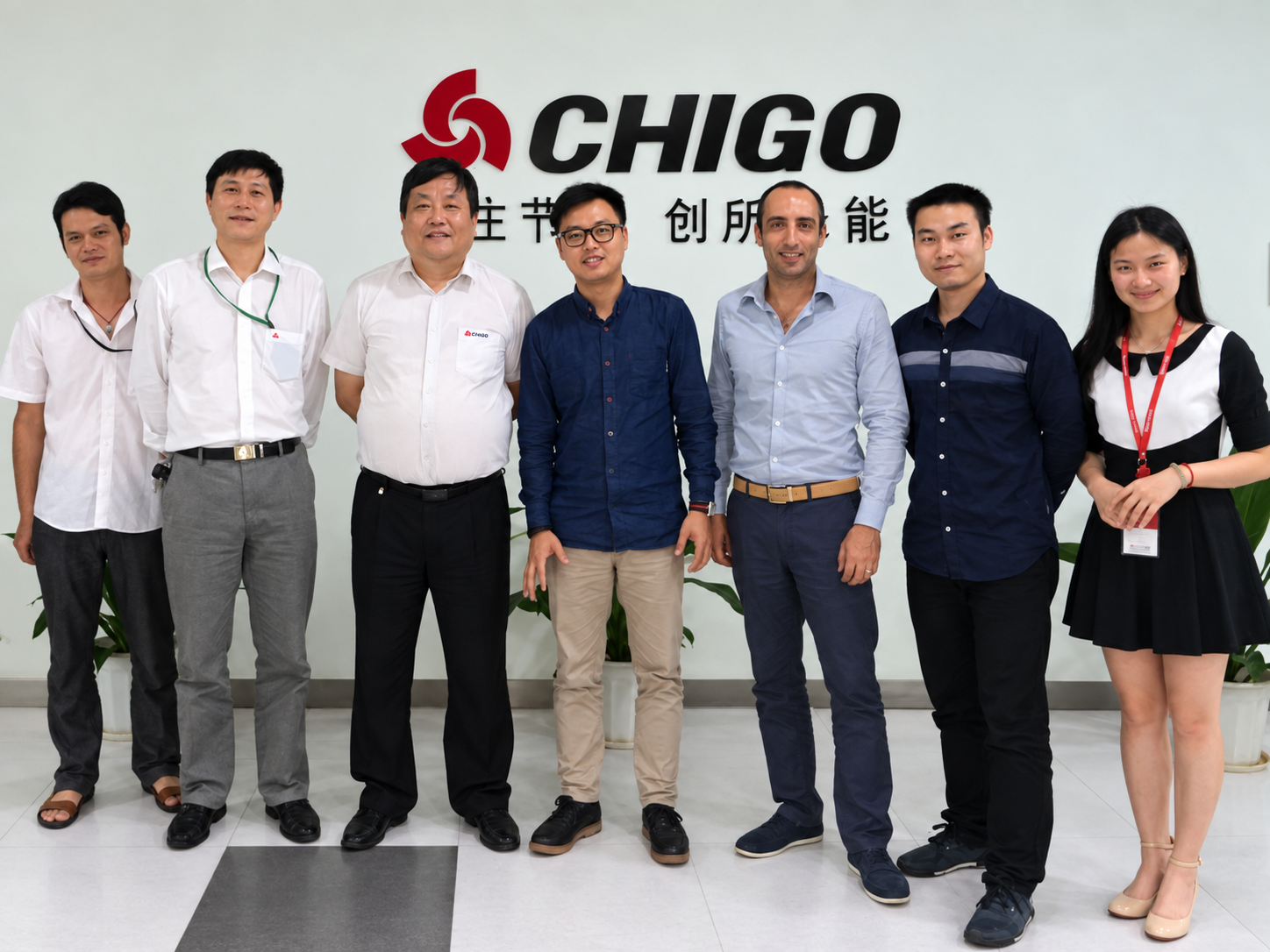
One of my early visits to a manufacturing company in Guangdong, during the years when I was beginning to understand a very different approach to product development.
In the first years I started working in China, I was still approaching product development with a mindset shaped mainly by my experience in Italy.
In Italy, when you develop a product for a client, you usually begin by understanding what that company can already do in-house. The design process is closely connected to the factory’s internal production capabilities. If a company has thermoforming in-house, you do not propose an injection-moulded product. If it works with a certain type of machining or assembly, you try to design around that setup. The product is tailored not only to the market, but also to the client’s internal industrial structure.
So when I started working with my first Chinese clients, my instinct was exactly the same. I immediately looked for information about their machinery, processes and production limits.
And almost every time I received more or less the same answer:
You develop the best design for the target market. We will find the way to make it.
At first, this answer surprised me.
What they meant was very simple, and very powerful: they were not asking me to limit the project to what they could already do inside their own factory. They were telling me that, once the right design direction had been defined, they would activate their local network to produce each component with the most suitable technology. One supplier would handle one part, another supplier another, and then everything would be brought back together and assembled on their own line — or, if necessary, even through another external partner.
In other words, they were not reasoning only as a single factory.
They were reasoning as part of a broader manufacturing ecosystem.
And I think this is one of the key differences.
In many European contexts, product development is still often conditioned by the perimeter of the individual company. The question tends to be: what can we produce internally, with our current setup?
In many Chinese contexts, the question is more often: what is the best product we can develop for this market, and how do we build the right supply chain around it?
This shift changes everything.
It means that design can start from a more market-oriented logic rather than from immediate production constraints. It means that the optimal production technology can be chosen component by component. It means that the industrial system is often more open, more modular, and more reactive.
And this is not a minor difference.
Because in contemporary product development, competitive advantage rarely comes from one isolated capability. It comes from the ability to coordinate many capabilities quickly and effectively: materials, moulds, engineering, electronics, finishes, packaging, sourcing, prototyping, testing and final assembly.
China has become extremely strong at this.
Not necessarily because every single company is better in absolute terms.
And not only because labor may still be cheaper in some cases.
But because the ecosystem is often denser, faster and more integrated.
This is why the Gucci case is interesting, even beyond the specific product or the footwear sector.
The lesson is broader.
The real issue is not whether Europe has good technology. It does.
The issue is whether these competencies are sufficiently connected, synchronized and accessible when a company needs to move fast and turn a design concept into an industrial reality.
This is where China often has a structural advantage.
Research, materials, tooling, component suppliers, process know-how and manufacturing partners are often geographically and operationally much closer. The distance between idea and execution is shorter. The number of iterations that can happen in a short time is higher. The dialogue between design and production is often more immediate.
This doesn’t mean that Europe has no answer.
But I believe Europe should stop comforting itself with the idea that China wins only because of low cost. That explanation may have been sufficient twenty years ago. Today it is not enough.
If we want to understand what is really happening, we need to admit that China has built a system that is often better at integrating design intent, industrial flexibility and execution speed.
This is not bad news.
It is a useful reality check.
Because once we understand where the strength really lies, we can also understand how Europe should respond.
The answer is not to imitate China blindly.
And it is certainly not to chase China only on volume.
Europe’s strength can be elsewhere: in smaller series, better customization, more direct dialogue with brands, higher process transparency, material culture, quality control, and in a different idea of industrial value.
But to compete seriously, this is not enough on its own.
We also need stronger integration.
We need industrial ecosystems, not isolated excellences.
We need suppliers, technologies and production partners that can work together earlier in the process, not only after the design has already been frozen.
We need to make the path from concept to production smoother, faster and less fragmented.
Because today the real competition is not only about who manufactures better.
It is about who can transform an idea into a product more effectively.
And on that terrain, the real Chinese advantage is no longer just cost.
It is system.
Source: Il Foglio, 1 October 2026
“Se Gucci fa sneaker in Cina, il problema non è la tecnologia italiana”
https://www.ilfoglio.it/moda/2026/10/01/news/se-gucci-fa-sneaker-in-cina-il-problema-non-e-la-tecnologia-italiana--409291
