
How we turn ideas into real products
A good product does not move from idea to production by accident.
Behind every successful physical product there is a sequence of decisions, corrections, tests and compromises that slowly transform an initial intuition into something manufacturable, usable and ready for the market. This process is rarely linear. Clients change direction, technologies impose limits, costs reshape priorities, prototypes reveal unexpected problems and production partners bring new variables into the project.
This is why we decided to make our design process more visible.
At SECCI Concept Design, we work with companies that want to develop real products, not just attractive images. Our role is to connect design vision, user experience, technical feasibility and manufacturing logic into a process that can move forward with clarity. Creativity is essential, but without structure it can easily become fragile. A good method does not limit creativity. It gives it a way to survive reality.
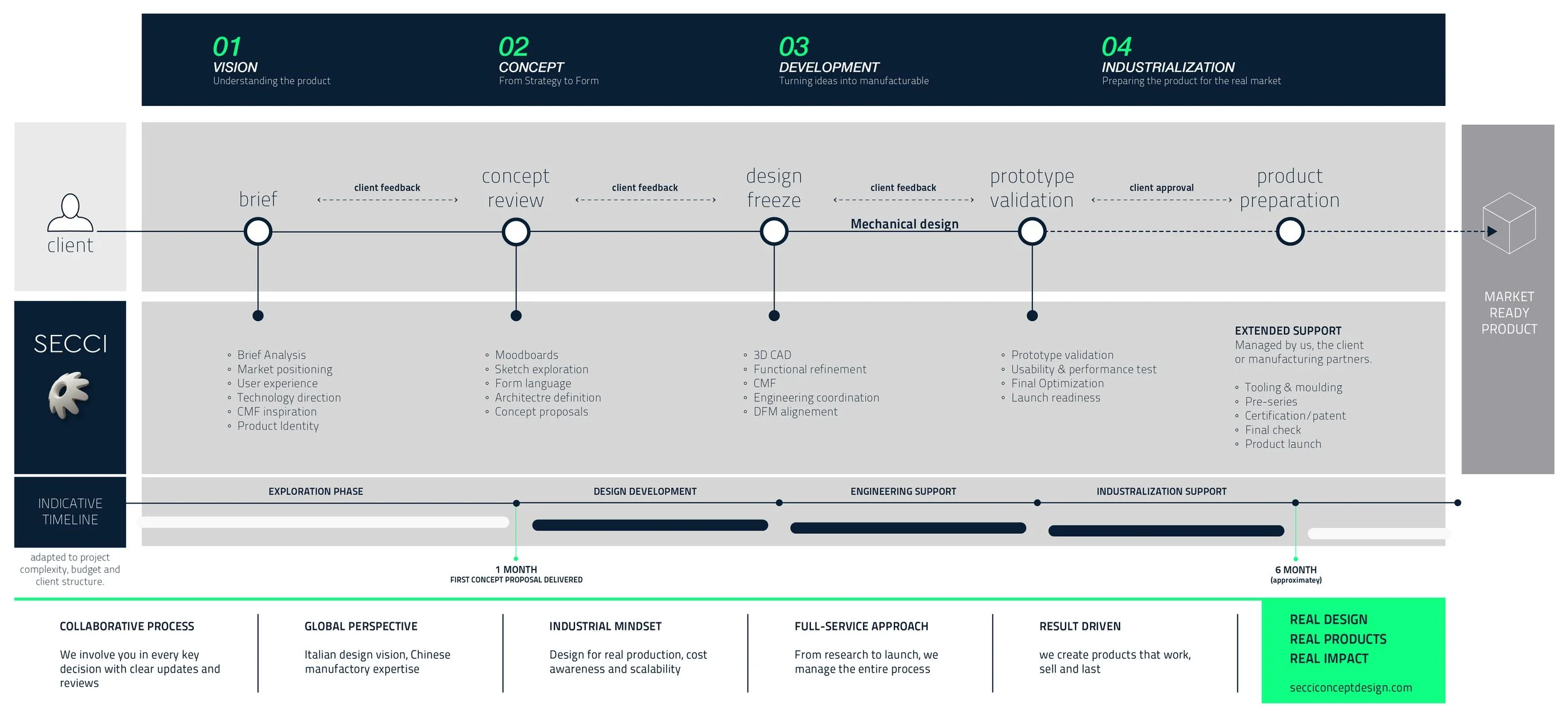
Our process is organized into four main phases: Vision, Concept, Development and Industrialization.
The first phase is
VISION
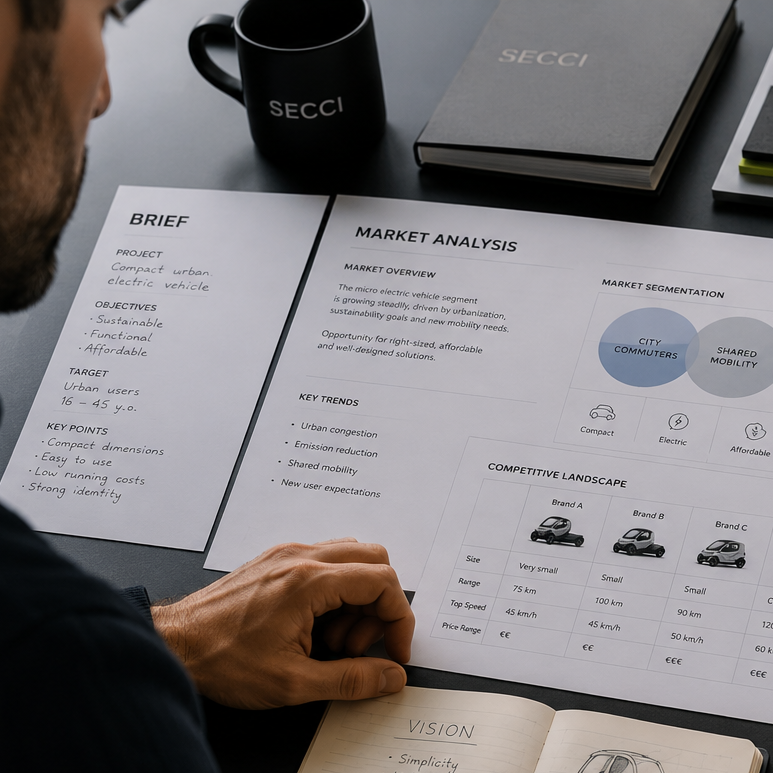
This is where we understand the product before trying to design it. We analyze the brief, the market positioning, the user experience, the technology direction, the CMF inspiration and the product identity. This early work is crucial because many design problems are not solved by drawing faster, but by asking better questions. Before defining the form, we need to understand what the product should become, who it is for, how it will be used and what kind of value it should bring to the company.
The second phase is
Concept
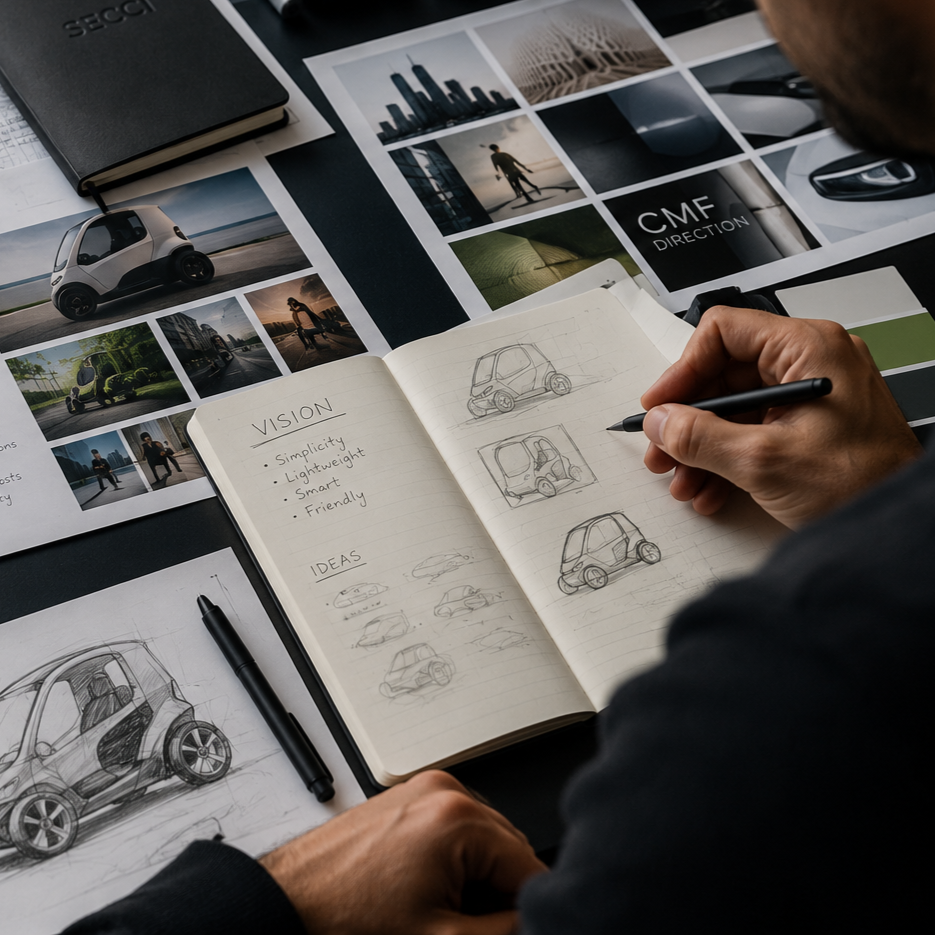
This is where strategy starts becoming form. We develop moodboards, sketch explorations, form language studies, architecture definitions and concept proposals. The goal is not simply to create beautiful alternatives, but to explore credible directions. At this stage, we give shape to the product vision, testing different possibilities and helping the client understand which direction has the strongest potential. After this phase, we usually deliver the first concept proposal within approximately one month.
The third phase is
DevelopmenT
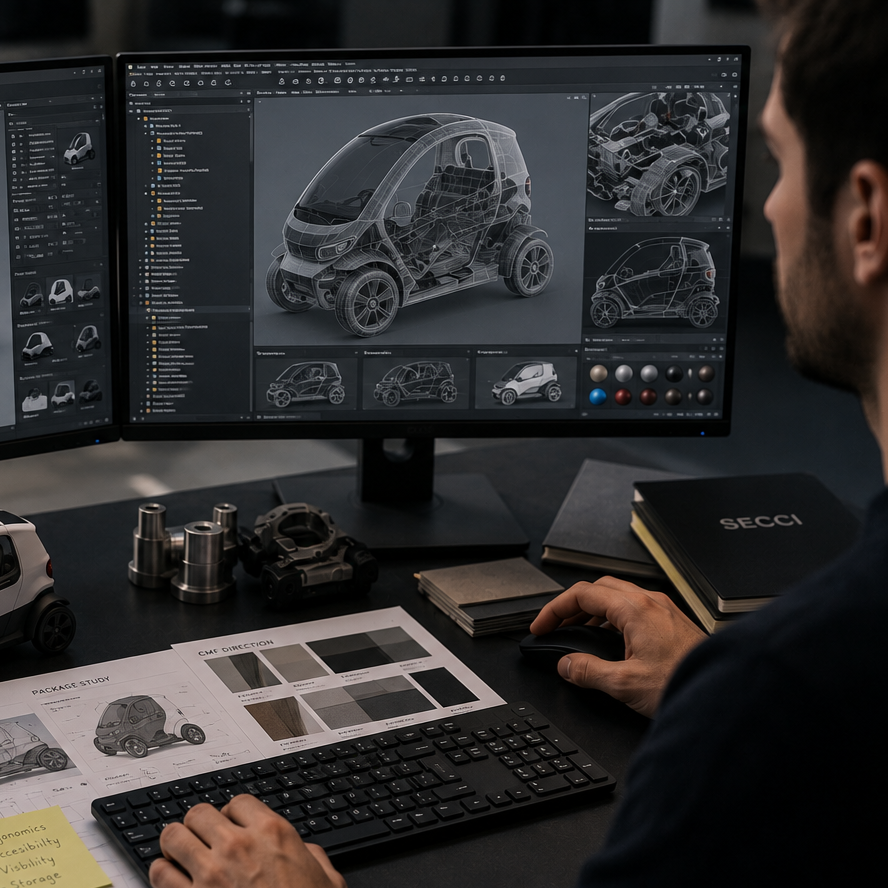
This is where ideas become more concrete. The selected concept is translated into 3D CAD, refined functionally, developed through CMF decisions, coordinated with engineering requirements and aligned with Design for Manufacturing principles. This phase is where many design projects either become stronger or start losing clarity. Details, surfaces, materials, components and technical constraints must work together. The design intent has to remain visible while the product moves closer to production reality.
The fourth phase is
Industrialization
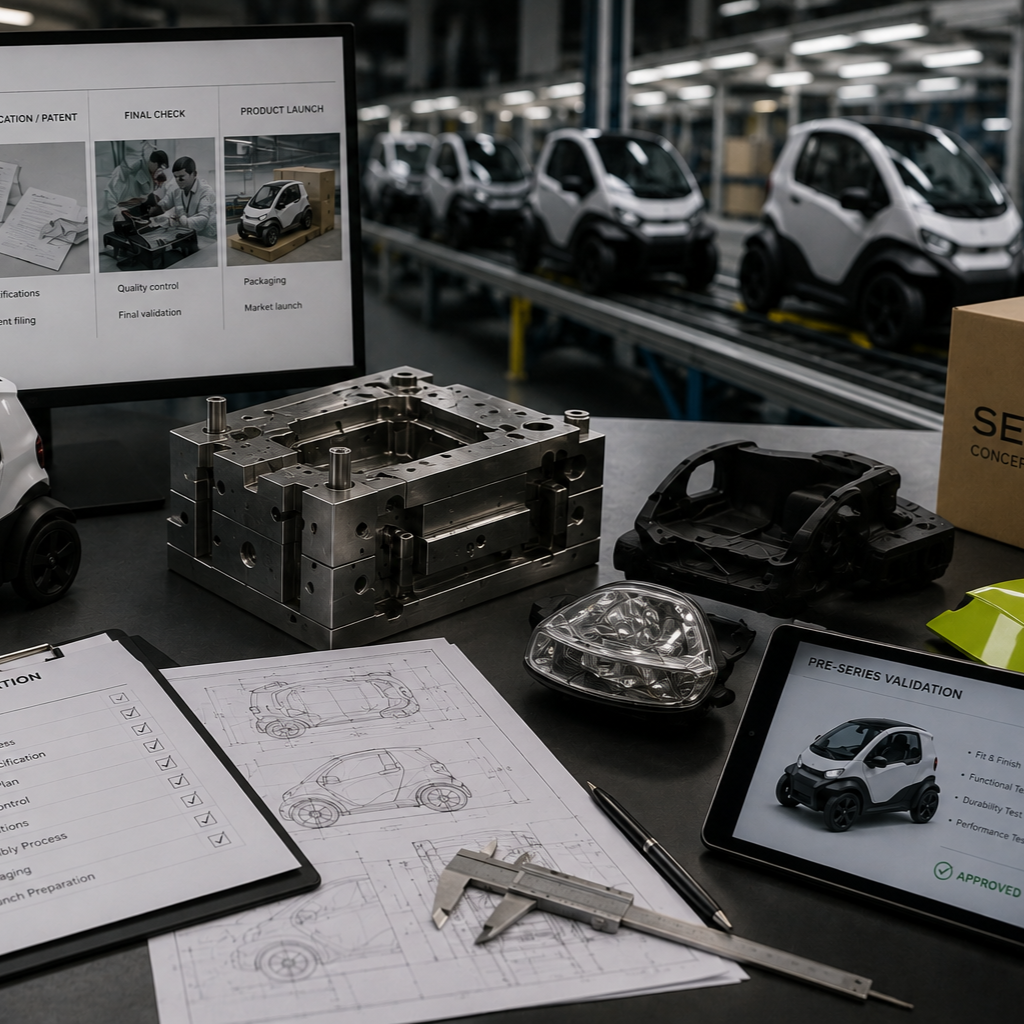
This is where the product is prepared for the real market. Depending on the project, this can include prototype validation, usability and performance testing, final optimization, tooling and moulding support, pre series control, certification, patent related coordination, final checks and launch preparation. This part of the process can be managed by us, by the client, by manufacturing partners, or through a shared structure depending on the company’s internal organization, budget and production strategy.
The full process can take approximately six months, although timing always depends on the complexity of the product, the level of engineering required, the client structure and the manufacturing context. Some projects are faster, others need deeper validation. What matters is not forcing every product into the same rigid path, but keeping the process clear enough to avoid confusion and flexible enough to adapt to reality.
Collaboration is central to this method.
We involve our clients in every key decision, with clear updates, reviews and feedback moments throughout the project. This allows companies to stay in control without being overwhelmed by the technical and creative complexity of the development process. Design is not something that should happen in isolation and then be presented at the end as a finished surprise. It is a continuous conversation between vision, business objectives, user needs, engineering constraints and production possibilities.
This approach reflects the way we understand industrial design.
For us, design is not only about creating an attractive object. It is about building a product that works, sells, lasts and can be produced with intelligence. It means considering cost awareness, scalability, materials, manufacturing technologies, user interaction and market positioning from the beginning, not as emergency corrections at the end.
This is also where our international perspective becomes important. SECCI Concept Design combines Italian design vision with long experience working with manufacturing partners in China and other production contexts. This allows us to move between creativity and industrial reality, between early concept and factory constraints, between ambition and feasibility.
Our goal is simple: helping companies turn ideas into real products.
Not just concepts. Not just renderings. Not just presentations.
Real design, real products, real impact.
